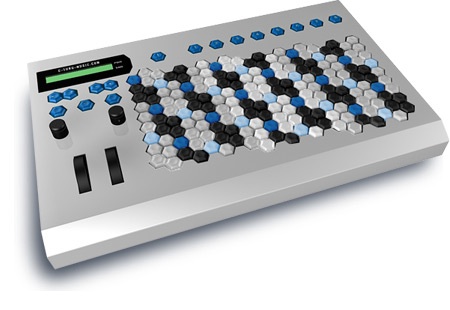
A Natural & Intuitive Note Layout
The Harmonic Table (map) is an arrangement of musical notes in an hexagonal lattice. It is isomporphic in that any combination of musical intervals has the same shape on the keyboard wherever it occurs. The layout is logical and is surprisingly effective for learning, playing, and understanding music.
It makes an awesome tool for composition.
- It's easy to explain the layout to anyone with some musical knowledge. So what?
- You could spend a long time analyzing the layout. There are lots of complications in music and plenty of note names and relationships to consider as well as details of and comparisons with other note layouts.
- You don't need any theoretical analysis or esoteric knowledge to use a Harmonic Table instrument sucessfully.
Note relationships
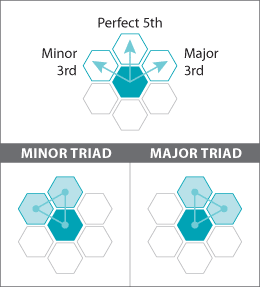
Starting from any note (the middle of the diagram), the next note up-to-the-left is a minor third above the starting note. The next note directly above is a fifth above the starting note, and the next note up-to-the-right is a major third above the starting note.
Semitones are in horizontal lines, like the semitone between Minor 3rd and Major 3rd.
In this arrangement, a minor triad (three note chord) has the shape of a left-facing triangle, and a major triad has the shape of a right-facing triangle.
The Harmonic Table pattern can be extended in all directions, and all intervals, chords and scales have the same shape in any key. See some chord shapes.

Why is that good?
The Shape = The Sound. The HT is a way to see and imagine musical harmony. When you play an HT keyboard it's see-hear-feel. You don't need to understand anything about sharps and flats (the black notes), and what makes them different to start playing. If you're used to black notes, it may help that the keysurface shows them as darker. However, in the Harmonic Table all notes are equal, and all notes have the same set of relationships with their neighbours.
Fingering
On many instruments, to play a chord or scale, fingering depends on your starting note. For instance, on a guitar with the usual tuning, the fingering of a scale will be different on the lower three strings compared to on the top three strings. (On the other hand, like bar chords, with the HT, same shape = same chord.)
Perhaps an easier example is the piano keyboard where there are twelve ways to finger a major scale (depending on your starting note). Eg C-major scale, start with your thumb on C: although this won't do for C# which is a black note and requires starting with a finger not a thumb.
On the HT keysurface the fingerings for C-major are the same for all major scales. The same is true for any scale or chord. Once you know a shape you know it in every key.
There is always more than one way to produce the same result on an Harmonic Table keysurface. This is because there is more than one instance of each note. A higher note can be found both to the left and to the right of a starting note.
Overall
The Harmonic Table helps you get to grips with music. All twelve notes of our Western scale fit into a logical pattern in a 2-dimensional surface.
As you use it, the layout becomes familiar and natural. You'll play recognisable tunes wihtin minutes, although being able to improvise will obviously take time.
With a little persistance you'll find that you can create with it much more easily than it might appear at first sight. Even DJ's can use it 
More
- What are the benefits of playing an HT keyboard,
- Try the Interactive Harmonic Table
- See some Testimonials and Quotes.
Performance MIDI Instrument
The AXiS-64 Pro MIDI controller is for performance and recording. It is fully featued and can handle complex set-ups. See the AXiS-64 page.
(and pictured on tour)
Composer's Music Interface
NEW Harmonic Table interface for your computer. The perfect extension to your DAW. No driver required, just plug it in (USB). See the AXiS-49 page.
[Top]